
Did an Antarctic meteorite establish ancient life on Mars?
ALH84001 was recovered in Antarctica in 1984. Its proposed biological signatures became controversial in 1996. A 2022 study examined mineral and organic associations and found evidence for organic synthesis through non-biological water-rock reactions. Organic carbon alone therefore does not establish fossil life.
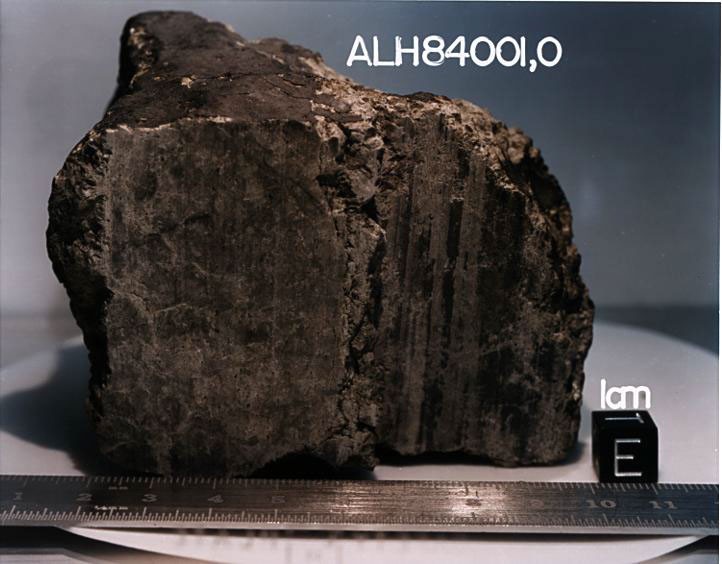
NASA/JSC/Stanford University, PIA00289
Factual educational/editorial use under NASA media guidelines; exact image page credits retained, no third-party copyright restriction observed. No endorsement or blanket public-domain claim.
The claim
Structures and organic material in the Martian meteorite ALH84001 were interpreted as possible evidence of ancient Martian life.
Evidence and competing explanation
Steele and colleagues used colocated nanoscale analyses to associate organic material with mineral carbonation and serpentinization. These are chemical pathways that do not require organisms.
What this does not establish
This finding concerns analyzed material and formation mechanisms in a particular meteorite. It is not proof that Mars never supported life. The specimen photograph shows the rock, not microscopic proof of organisms. Older NASA image captions contain an outdated age; no exact formation age is asserted here.